
How to Choose a Food Contact Compliant Halloween Cookie Box
For bakery brands, confectionery manufacturers, and seasonal packaging buyers, a food contact compliant Halloween cookie box must balance eye-catching design with food safety. Deep black, vibrant purple, and pumpkin orange graphics help create a distinctive holiday look. Meanwhile, suitable paperboard, printing inks, adhesives, and protective coatings help reduce contamination risks.
However, choosing food-grade paperboard alone does not establish that the finished packaging is safe for its intended use. Printing, lamination, gluing, and other converting processes can introduce additional substances or affect the package’s barrier performance.
To source compliant Halloween cookie packaging, procurement teams should evaluate the complete packaging structure, match materials to the cookies’ characteristics, and request documentation that covers the finished product.
1. What Makes a Halloween Cookie Box Food Contact Compliant?
A food-contact-compliant Halloween cookie box depends on more than its base paperboard. Every component must be suitable for its intended application, and the complete packaging structure must be evaluated against applicable food-contact requirements.
The main components include structural paperboard, printing inks, adhesives, surface finishes, and any inner liner or tray.
| Packaging component | Common material options | Potential food safety risks | Procurement recommendations |
|---|---|---|---|
| Structural paperboard | Virgin SBS board or kraft paperboard | Unsuitable additives, contaminants, or substances that may migrate | Request material specifications and documentation for the intended food-contact conditions |
| Printing inks | Conventional inks or low-migration formulations | Migration of ink constituents, photoinitiators, mineral oil hydrocarbons, or other substances | Confirm ink suitability, curing conditions, and migration-control measures |
| Adhesives | Packaging-grade laminating or folding adhesives | Residual substances or migration through the packaging structure | Verify intended-use suitability and adhesive application controls |
| Surface finish | PP film lamination, aqueous coating, or varnish | Unsuitable coating ingredients, inadequate curing, or insufficient barrier performance | Select a finish based on food-contact conditions, grease resistance, and applicable requirements |
| Inner food-contact layer | Glassine, suitable plastic film, or a food-contact tray | Direct contact with unsuitable materials, grease penetration, or moisture damage | Specify a suitable liner or tray when the outer box cannot safely contact the cookies directly |
The correct material combination depends on whether the cookies contact the paperboard directly, whether they contain substantial amounts of fat, and how the packaged products will be stored and transported.
For US-bound packaging, relevant FDA regulations include 21 CFR 176.170 for certain paper and paperboard components used with aqueous and fatty foods and 21 CFR 176.180 for certain dry-food applications. These regulations have specific conditions and limitations, so buyers should verify which provisions apply to their packaging.
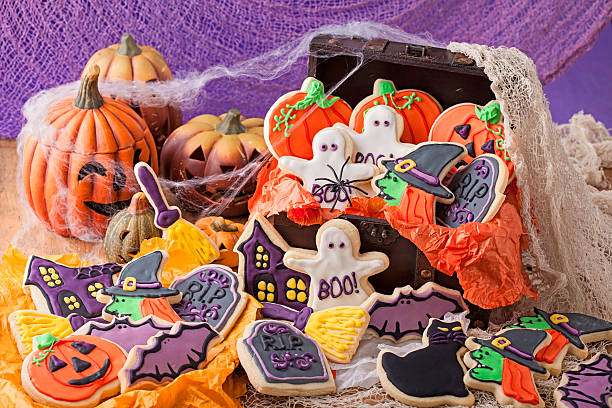
2. Three Food Safety Risks in Halloween Cookie Packaging
Risk 1: Heavy Ink Coverage and Chemical Migration
Halloween packaging often features saturated black, violet, and orange graphics. These designs can require substantial ink coverage, making ink formulation, drying, curing, and migration control important considerations.
Depending on the ink chemistry and printing process, potential concerns may include photoinitiators, mineral oil hydrocarbons such as MOSH and MOAH, residual solvents, and other substances that could transfer through the packaging structure.
The risk depends on the specific formulation, application conditions, food-contact arrangement, and presence of functional barriers. Dark colors do not automatically make packaging unsafe, and vegetable-based or soy-based inks are not automatically compliant simply because of their raw materials.
What buyers should request:
- Ink specifications identifying suitability for the intended packaging application.
- Evidence of low-migration performance where relevant.
- Information on curing, drying, and production controls.
- Migration assessment or test reports appropriate to the final packaging structure.
For printed folding boxes, keeping printing on the outer surface and preventing direct food contact can help reduce exposure. However, this approach alone does not prove that migration cannot occur through the paperboard or other packaging layers.
Risk 2: Lamination, Aqueous Coatings, and Grease Resistance
Cookies can contain butter, oils, chocolate, and other fat-rich ingredients. These ingredients may interact with packaging materials, causing grease stains or increasing the importance of selecting suitable contact surfaces and barriers.
The best surface treatment depends on the product, packaging design, and intended contact conditions.
| Surface treatment | Key advantages | Main considerations | Potential applications |
|---|---|---|---|
| PP film lamination | Can provide a useful barrier against grease and moisture | Film, adhesive, and processing conditions must be suitable for the intended use | Premium cookie boxes and packaging requiring additional grease protection |
| Aqueous coating | Supports printed finishes and may offer a paper-based alternative to film lamination | Grease resistance varies by formulation; not every aqueous coating is suitable for direct food contact | Decorative cookie boxes with a separate food-contact liner |
| Food-contact glassine liner | Separates cookies from the printed outer box and can help manage grease transfer | Performance depends on the grade, construction, and food-contact suitability | Individually arranged cookies and assorted bakery products |
| Food-contact tray or inner packaging | Helps separate products and organize assortments | Adds material and may affect cost, dimensions, and recyclability | Gift assortments, delicate cookies, and premium seasonal sets |
A PP laminate should not automatically be described as an impenetrable barrier. Its performance depends on the film, adhesive, thickness, seams, edges, and manufacturing quality. Likewise, an aqueous coating should not be assumed to provide sufficient grease resistance without supporting specifications or testing.
For high-fat cookies, ask suppliers to confirm barrier performance under realistic storage and handling conditions. If the outer box is not intended for direct food contact, a suitable inner liner, tray, or individual food-safe wrapper can provide a more clearly defined contact layer.
Risk 3: Relying on Raw Material Certificates Instead of Finished-Package Evidence
A common procurement mistake is accepting a paperboard certificate as proof that the entire printed and converted box complies with food-contact requirements.
The finished packaging may contain multiple materials, including inks, adhesives, laminating films, coatings, and liners. Their interactions and processing conditions can affect the final assessment.
For this reason, buyers should request documentation that identifies the complete packaging construction and its intended use.
A practical supplier verification process includes:
- Confirm the intended application. Specify the cookie type, fat content, direct-contact arrangement, storage duration, and relevant temperature conditions.
- Review component documentation. Collect specifications for the paperboard, inks, adhesives, coatings, laminates, and inner packaging.
- Assess the finished structure. Determine whether migration testing or other evidence is needed for the complete packaging system.
- Verify market requirements. Identify the applicable rules for the destination market and intended use.
- Retain traceable records. Keep material specifications, test reports, declarations, and production information for the approved packaging design.
For US shipments, the FDA evaluates food-contact substances under applicable regulatory provisions; a generic paperboard certificate should not be treated as universal approval of the finished box.
For EU-bound packaging, Regulation (EC) No 1935/2004 provides the general framework for food-contact materials, while Regulation (EU) No 10/2011 specifically addresses plastic materials and articles intended to contact food. Buyers should determine which rules apply to each component rather than assuming the plastics regulation covers the entire paperboard box.
3. How to Verify Food Contact Compliance Before Placing a Bulk Order
Seasonal packaging often involves fixed launch dates and large order quantities. Verifying compliance during supplier selection can help reduce the risk of reprinting, production delays, or rejected shipments.
Use the following checklist when evaluating a custom Halloween cookie box supplier.
| Verification item | Questions to ask the supplier | Evidence to request |
|---|---|---|
| Paperboard | Is the material suitable for the intended food-contact application? | Material specifications and applicable compliance documentation |
| Printing inks | Are the inks appropriate for the packaging structure and printing conditions? | Ink specifications and relevant migration-control evidence |
| Adhesives | Are the adhesives suitable for the intended use and properly processed? | Technical data and supporting compliance documentation |
| Surface finish | Does the laminate or coating provide the required grease and moisture resistance? | Coating or film specifications and performance evidence |
| Inner liner | Will cookies contact the outer box directly? | Liner or tray specifications and suitability documentation |
| Finished packaging | Has the complete structure been assessed for the intended use? | Applicable declaration, assessment, or migration test reports |
| Production consistency | Can the supplier maintain the approved material and printing specifications across repeat orders? | Approved specifications, batch traceability, and change-control procedures |
A Declaration of Compliance (DoC) may be appropriate or required for particular materials and markets. Its availability and scope depend on the applicable regulatory framework. Buyers should verify that any declaration covers the relevant materials, intended use, and packaging construction rather than relying on the document title alone.
Testing should also match the actual risk. Heavy metal extraction, overall migration, and specific migration tests address different questions. EN 71-3 is a standard concerning the migration of certain elements from toys; it should not be used as a universal substitute for food-contact compliance testing.
4. B2B Procurement FAQs
Q1: Do black, purple, and orange Halloween cookie boxes require additional food safety testing?
Not automatically. Dark or saturated artwork can increase the amount of ink applied, but color alone does not determine compliance.
Buyers should assess the ink formulation, printing process, food-contact arrangement, and potential migration pathways. Additional testing may be appropriate when the packaging materials, intended use, or existing documentation indicate a risk that requires verification.
Q2: Is PP lamination safer than aqueous coating for cookie boxes?
Neither option is universally safer. Both must be evaluated for the intended application.
PP lamination may offer useful grease and moisture resistance, while aqueous coatings can support certain paper-based packaging designs. The choice should consider the complete material system, including adhesives and processing conditions.
For direct-contact applications, confirm that the finished contact surface is suitable for the intended cookies. Alternatively, use a suitable inner liner or tray to separate the food from the printed outer box.
Q3: What documents should I request for custom Halloween cookie boxes?
Start by requesting:
- Paperboard, ink, adhesive, coating, and liner specifications.
- Applicable food-contact declarations or compliance statements.
- Relevant migration test reports or risk assessments.
- Documentation identifying the intended food types and conditions of use.
- Production traceability and confirmation of material consistency.
The precise documentation depends on the destination market, packaging construction, and whether the cookies contact the box directly.
Q4: Can a food-grade paperboard certificate guarantee that the finished box is compliant?
No. A paperboard certificate only supports the claims within its scope. It does not automatically establish the compliance of added inks, adhesives, coatings, or laminates.
Ask the supplier to explain how the finished packaging structure has been evaluated for its intended use.
Q5: How can I combine premium Halloween printing with food safety requirements?
Define both the visual requirements and the packaging’s functional requirements before approving production. Specify the desired colors, matte or gloss finish, grease resistance, direct-contact arrangement, and target market.
Then ask the supplier to recommend suitable materials and provide supporting documentation. Approve the final printed sample and packaging construction before placing a large seasonal order.
5. Key Takeaways for Halloween Cookie Box Buyers
A successful food-contact-compliant Halloween cookie box must combine seasonal visual appeal with a suitable, documented packaging structure.
- Evaluate every layer: Paperboard, inks, adhesives, coatings, and liners all matter.
- Control migration risks: Assess ink formulations, curing conditions, and possible migration pathways rather than judging safety by ink color alone.
- Match the barrier to the product: Consider the fat content, moisture exposure, and intended food-contact arrangement when choosing laminates, coatings, or inner liners.
- Verify the finished package: Raw material documentation alone may not establish compliance for the converted box.
- Check destination-market requirements: Confirm which regulatory provisions and tests apply to the specific materials and intended use.
Source Custom Halloween Cookie Boxes with Confidence
For bakery brands and confectionery manufacturers, seasonal packaging needs to deliver more than vibrant Halloween graphics. It should also provide appropriate product protection, consistent manufacturing quality, and documentation that supports the intended food-contact application.
When developing a custom Halloween cookie box, share your artwork, box dimensions, cookie specifications, destination market, and preferred finish with your packaging supplier. Request material recommendations and relevant compliance evidence before confirming mass production.
Planning your next seasonal packaging order? Contact a custom packaging manufacturer to discuss your Halloween cookie box design, material options, food-contact requirements, and wholesale production needs.